
According to recent data, up to 77% of US households use some type of water treatment or filtration device. Among homeowners living in areas with high levels of hard water, American Valve found that only 17% report experiencing no hard water or scale-related issues.
Because of this, many homeowners install equipment designed to prevent limescale buildup in faucets, water heaters, and other plumbing fixtures, in addition to their water filtration system.
Understanding how water treatment systems and limescale inhibitors interact, and where they should be installed, is an important step in designing an effective, efficient, and limescale-free home water system.
Types of water treatment systems
There are several technologies commonly used to improve household water quality. These systems are designed to remove contaminants, improve taste and odor, and protect plumbing equipment.
Common water treatment systems include:
Activated carbon filters
Activated carbon filters use granular charcoal media to absorb chlorine and volatile organic compounds (VOCs). This device is mostly used to improve the taste and odor of tap water.
Reverse osmosis filters
Reverse osmosis filters leverage a semi-permeable membrane to remove dissolved, solids, metals, and other chemicals and contaminants from drinking water.
UV filtration systems
UV filtrations systems feature ultraviolet light that kills harmful viruses and bacteria. These systems are frequently used in well water home systems.
Sediment filters
Sediment filters filter out heavier contaminants such as sand, dirt, and other debris. These are typically installed as the first stage of a home water treatment system and are often used alongside other filtration technologies.
Leveling up your water treatment system
While the technologies listed above can improve the taste and quality of your drinking water, they do not prevent the limescale formation that is caused by hard water minerals.
Approximately 85% of US households live in an area with hard water. Limescale accumulation can cause a litany of costly issues, including:
- Tough-to-clean stains around faucets and fixtures
- Reduced water pressure
- Decreased energy efficiency for water heater and appliances
- Shortened equipment lifespans
To alleviate these challenges, homeowners often install a limescale inhibitor to pair with their water filtration system.
Knowing how and where these limescale inhibitors should be installed is crucial, and it is completely dependent on what type of water treatment system you currently have.
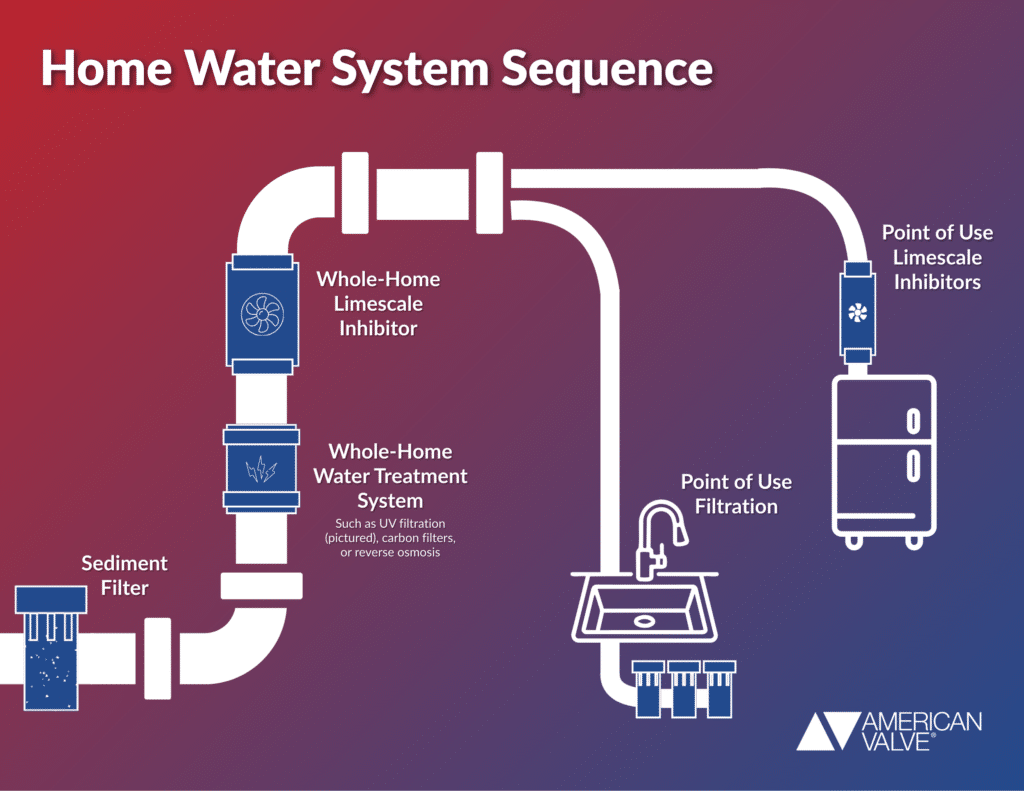
Below are general guidelines for how these systems are typically arranged.
Recommended Order for Water Treatment and Limescale Protection
1. Sediment filters
Sediment filters are often the first component in a home water system.
These filters remove large particles of debris and protect downstream equipment. They are especially critical for well water systems or in areas where the municipal water system has a high level of solids.
2. Whole-home water treatment system
Next in line, downstream from the sediment filter, is the main water treatment system.
These provide clean, filtered water to the entire residence. The water treatment system’s job is to remove odors, VOCs, germs, and bacteria.
3. Whole-home limescale inhibitor
After the water treatment system comes the whole-home limescale inhibitor.
Installing the limescale inhibitor after the water treatment system helps prevent treated water from forming mineral buildup on:
- Pipes
- Plumbing home fixtures
- Water heater materials
- Household appliances
4. Point of use filtration and limescale inhibitors
Some homeowners also utilize point of use filtration systems.
These devices typically use activated charcoal filters to improve the taste and odor of drinking water at sinks or appliances, but may also incorporate particulate filters.
Homeowners may also choose to install a point-of-use limescale inhibitor. These should be installed downstream (after) the filter. However, they can also be installed upstream (before the filter) if the home’s water system is free of debris.
Typical Order of a Home Water Treatment System
| System Component | Purpose | Typical Installation Position |
|---|---|---|
| Sediment filter | Removes sand, rust, and other debris | First stage |
| Water treatment system | Improves taste and removes contaminants | After sediment filter |
| Whole-home limescale inhibitor | Prevents mineral scale buildup | After water treatment system |
| Point-of-use filter | Further improves drinking water quality | At specific fixtures |
| Point-of-use limescale inhibitor | Prevents scale at appliances and faucets | Usually after filter |
Conclusion
In most residential plumbing systems, whole-home limescale inhibitors should be installed after sediment filters and other water treatment equipment.
Point-of-use limescale inhibitors offer the most flexibility and can sometimes be installed either before or after a filter, provided the system is free of large debris.
When designed properly, a home water system that combines water treatment technologies and limescale inhibitors can help deliver:
- Cleaner, better-tasting water
- Reduced mineral buildup and damage on fixtures
- Improved appliance efficiency
- Longer plumbing equipment lifespan
FAQ
Should a limescale inhibitor be installed before or after a sediment filter?
A limescale inhibitor should typically be installed after a sediment filter.
Sediment filters remove debris that could interfere with the inhibitor’s performance.
Do limescale inhibitors work with reverse osmosis systems?
Yes. A limescale inhibitor can be installed downstream of whole-home filtration systems, including reverse osmosis pre-treatment equipment.
Do I still need filtration if I install a limescale inhibitor?
Yes. Limescale inhibitors help prevent mineral buildup, but they do not remove contaminants, chlorine, or bacteria.
Filtration systems are still necessary for improving water quality.
Discover more about how to troubleshoot your limescale inhibitor and monitor for effective results.
The data cited in this article is the result of market research conducted by the American Valve team in February, 2026. This information is being provided for informational purposes only. The survey polled 1,000 U.S. homeowners, and respondents cover all age groups (18 and older), regions, and genders. The margin of error for this data is +/- 3%.